
Postpartum Belly Binding: What It Can and Can't Do
By Cris Dima, Pre/Postnatal Fitness Specialist, Core Confidence Specialist, KGH Hypnobirthing Practitioner, IIN Certified Health Coach
There is a moment, in the first days after birth, when a Mother looks down at a belly that still looks pregnant in a way no one warned her about, and something in her body asks to be wrapped, held, and gathered back toward center.
Are postpartum belly binders worth it? Often yes, as short-term comfort and support, if the wrap goes on from the bottom up and is never so tight that you cannot breathe into your belly. No, as a way to flatten your belly for good or to close diastasis recti, because a wrap is not a fix for either.
The instinct to wrap is a very old one, and it is not wrong. What goes wrong is how most Mothers are handed the method: a length of fabric from an online shop, a few rules, and no reason behind them, when a wrap applied the wrong way or too tightly can push pressure down onto a pelvic floor that is still healing. This article begins with the reason.
What Belly Binding Is
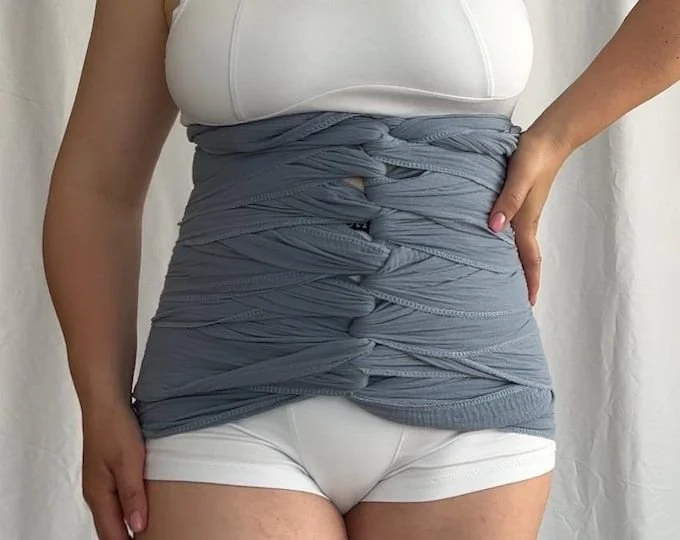
Belly binding is the practice of wrapping the abdomen after birth with a length of cloth, traditionally muslin or cotton and sometimes a modern elastic wrap, to offer gentle compression to the belly, low back, and hips in the weeks after birth.
It is an old practice. The bengkung in Malaysia and Indonesia, the faja across Latin America, and the sarashi in Japan each sit inside a much larger system of postpartum care made of heat, rest, seclusion, and food as medicine, and in its original context binding was never the whole practice but one thread in a much larger cloth.
What is sold today is usually that thread alone, pulled out of its cloth: a wrap and a set of instructions, with the rest of the tradition left behind. That is not necessarily wrong, but it means the how matters more than ever, because the container that once held this practice, an elder, a lineage, a whole system of care, is no longer there to catch a Mother if she gets it wrong.
Why Direction and Fit Matter
A wrap changes where pressure goes in your body, whether you intend it to or not. Every breath, cough, laugh, and lift of your baby moves pressure through your middle, and a wrap sits directly in the path of it.
Picture a closed soda can squeezed around the middle. The pressure inside does not disappear. It has to go somewhere, and it goes toward whatever gives first.
After birth, what gives first can be your pelvic floor, which has carried a pregnancy, absorbed the work of labor or a surgical birth, and is still healing. Asking it to take extra pressure is not support, and it can be a demand on tissue that needs rest.
This is why direction and fit matter so much: they decide whether a wrap supports you or strains you.
The way Bellies Inc, co-founded by Kim Vopni, teaches it, the rule is blunt: "You MUST wrap from the bottom up." The thinking is that starting low and gathering upward gives the pressure somewhere to go, while wrapping top-down does the opposite, pushing that pressure down onto a pelvic floor that is still healing, which can mean strain on it over time.
Fit follows the same logic. Snug enough to feel held is the goal, and if you cannot take a full breath into your belly, the wrap is too tight and needs loosening before anything else.
You do not need to understand anatomy to use any of this. You need a direction and a breath, because the same cloth does something different depending on where you start winding it.
Timing: When to Begin, and How Long to Wear It
Timing follows the same logic as direction, because a body needs enough healing underway before it can bear compression at all.
Vaginal birth: many practitioners suggest waiting until day 4 to day 7 postpartum, once the earliest swelling has started to settle
Cesarean birth: only once the incision has fully closed and your surgeon has cleared you. If your surgical team gave you a binder or specific instructions, follow those, not this post
Most practitioners recommend wearing a wrap through about 6 to 8 weeks postpartum
Wrap from the bottom up, never top-down
Supportive, not squeezing: if you cannot take a full breath into your belly, it is too tight
You will see some sites say to start on day one or two. The more cautious range above is the one to follow.
Think of the 6 to 8 weeks as a window rather than a deadline. The wrap supports the first weeks of healing, and after that your own strength is meant to take over from the cloth.
If your surgeon or midwife gives you a different timeline for your specific body, that instruction outranks every general rule in this post, including this one. And if a wrap ever brings pelvic heaviness, pressure, leaking, new pain, or anything that worries you, take it off and tell your midwife, doctor, or pelvic floor physiotherapist.
What Belly Binding Cannot Do
It is worth being clear about what a wrap was never built to do. Some popular sources claim that belly binding helps close diastasis recti, the separation of the abdominal muscles that widens to make room for a baby. The research does not show that.
What is true: binding can offer a felt sense of support and containment while your body heals. Whether it adds anything on top of core rebuilding work, the kind where your own deep muscles learn to do the holding again, is still unclear, and the research on that combination is limited and mixed.
What is not true: that binding closes the gap on its own. The research does not show it does, and where studies compare the two, exercise has done better than compression at narrowing the gap.
External compression can hold a shape from the outside, but it cannot teach your own muscles to hold that shape from the inside, and that inside work is what closing the gap asks for.
If diastasis recti is what you are working with, our post on diastasis recti after birth explains what it is and how a core rebuilds its strength over time, and a pelvic floor physiotherapist can look at your own body in a way no blog post can.
It would be easy to promise a shortcut, and a shortcut that does not work is not a kindness. A wrap can sit alongside your healing, but it is not the healing itself. What the early weeks mostly ask for is slower and plainer than any product: rest, warmth, good food, and people who will carry things for you. Core strength returns gradually, once your body is ready for it.
The Instinct Underneath the Practice
A body that has spent months opening asks, urgently, to be gathered back, which is why fabric around your middle can feel like relief instead of restriction.
Belly binding comes from the same instinct as Closing the Bones, a ceremony practiced by indigenous midwives in Mexico and Ecuador for generations. Where a binder wraps the belly, Closing the Bones gathers the entire body, feet to crown, every joint that opened during pregnancy and birth, through the slow, sequential compression of a rebozo in the hands of a trained practitioner.
A binder speaks to your abdomen. It cannot speak to your hips, your sacrum, your nervous system, the parts of you that also opened and are also waiting to be told: you can close now. You are safe to gather back.
I now hold the Closing Ceremony myself, in Barcelona and Girona, Spain, and you can read how it works on the Closing Ceremony page.
And if you are looking for care that holds your whole postpartum body as one system, rather than a belly wrapped in isolation, Chrysalis was built for exactly that passage.
A Gentle Start If You’re Unsure
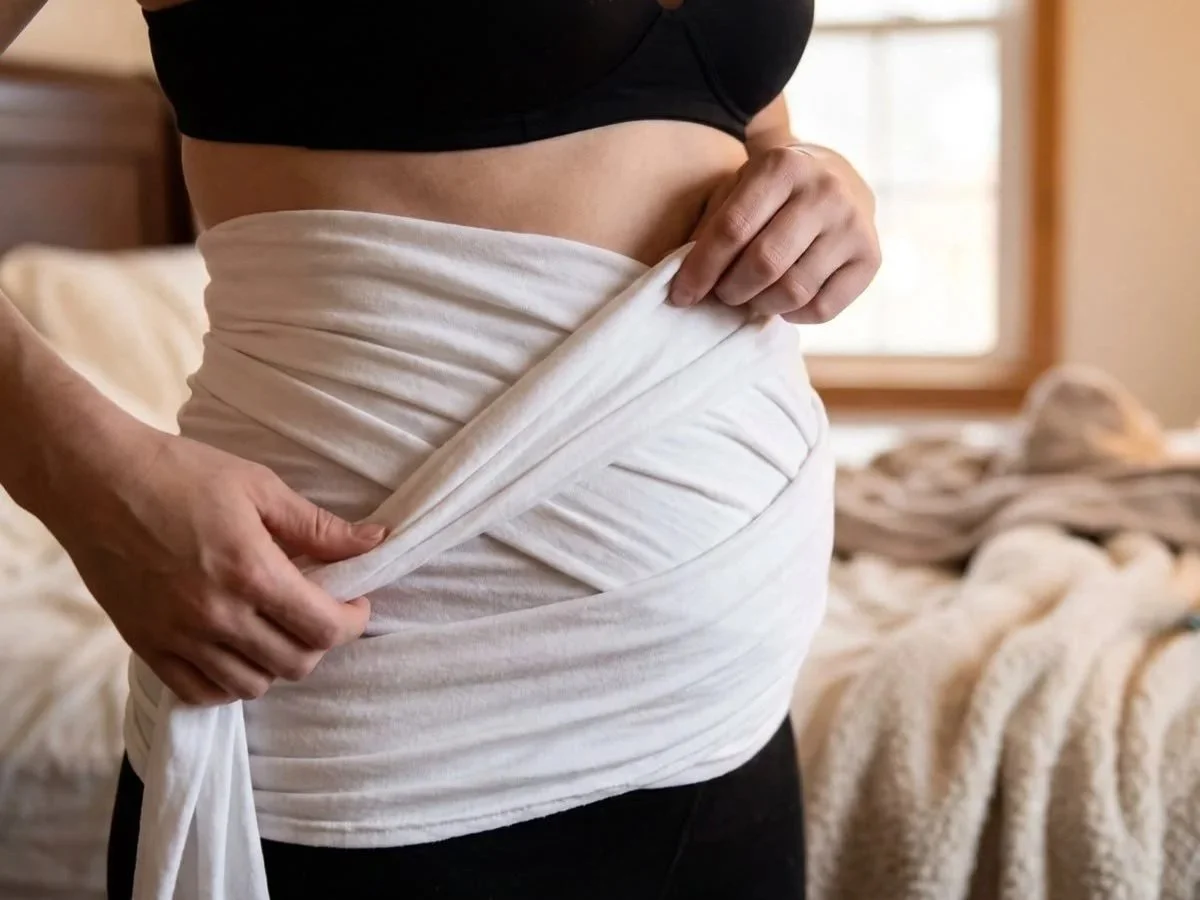
Reaching for a wrap is a fine place to start. A wrap may feel comforting for a few weeks before it is put down, and some Mothers never reach for one at all. If something in you is still asking for more than fabric can give, there is more to reach for.
Whatever you choose to wrap with, let rest come first. Your body is not asking to be fixed. It is asking to be held.
Frequently Asked Questions
Are postpartum belly binders worth it?
Often yes, as short-term comfort and support, if you wrap from the bottom up and never so tight that you cannot breathe into your belly. No, if you are hoping a binder will flatten your belly for good or close diastasis recti, because the research does not show it closes the gap, and any change to your shape lasts only while you wear it. Binding is generally a weeks-long practice, about 6 to 8 weeks postpartum, and your care provider has the final word on what suits your body.
Does postpartum belly binding help flatten your belly?
Binding can create a felt sense of support and a smoother silhouette while you wear it, but that effect is temporary and it comes from the outside. It is not shown to change your underlying muscle tone, your tissue healing, or diastasis recti. That comes from your body's own recovery and, where needed, real core rebuilding work.
Which way should you wrap a postpartum belly binder?
Wrap from the bottom up, never top-down. The reasoning is that bottom-up wrapping lets pressure move upward, while top-down wrapping pushes it downward onto a pelvic floor that is still healing, which can strain it over time.
When can I start belly binding after a vaginal birth?
Many practitioners suggest waiting until day 4 to day 7 postpartum, once the earliest swelling has begun to settle. Always let your own recovery and your care provider's guidance take priority over any general timeline.
Is belly binding safe after a C-section?
Only once your incision has fully closed and your surgeon has cleared you. If your surgical team gave you a binder or specific instructions, follow those, not this post. Ask your surgeon before wrapping over an incision that is still healing.
How long should you wear a postpartum belly wrap?
Most practitioners recommend wearing a wrap through about 6 to 8 weeks postpartum. Beyond that window, the priority shifts from external support toward rebuilding your body's own core strength.
Is it too late to start belly binding at 3 months postpartum?
Binding is generally described as a weeks-long practice, about 6 to 8 weeks postpartum, so by 3 months the focus has usually moved toward rebuilding your own core strength. If a wrap still feels comfortable and you can breathe fully into your belly, ask your care provider or a pelvic floor physiotherapist whether it suits your body.
Can belly binding fix diastasis recti?
No. The research does not show that binding closes the gap on its own, and where studies compare the two, exercise has done better. Whether binding adds anything on top of an exercise program is still unclear. A wrap can offer support and a sense of containment, but closing the gap comes from your own deep muscles learning to hold again, not from compression.
What is the difference between belly binding and Closing the Bones?
They come from the same instinct, but they are different practices. Belly binding is a wrap for the abdomen, applied by you or a partner. Closing the Bones is a full-body ceremony held by a trained practitioner, using a rebozo to gather every joint that opened during pregnancy and birth.