
Diastasis Recti After Birth: What It Is, How to Measure It, and How to Restore Your Core
There is a moment many Mothers remember from the early weeks after birth, when they lie back on the bed, lift their head to look down at the baby on their chest, and see the center of their belly rise into a soft ridge along the midline, like a tent drawn up between two poles.
For many women, that ridge is the first time they meet the words diastasis recti. And what they usually find next is either silence from their care provider or a flood of fear online: lists of forbidden movements, promises of a flat belly in thirty days, and very little that explains what is actually happening in the tissue of the body, or how that tissue heals.
This article is here to offer what was missing: a clear understanding of what diastasis recti is, how to measure it with your own hands, and how the abdominal wall, patiently and progressively, regains its integrity after birth.
What Diastasis Recti Is (And Why It Is Not a Failure of Your Body)
Diastasis recti abdominis is the widening of the space between the two bellies of the rectus abdominis, the long vertical muscles that run from your ribs to your pubic bone, together with a thinning and stretching of the connective tissue that joins them along the midline, a band called the linea alba.
During pregnancy, as the womb grows upward and outward, the abdominal wall has to make room, and it does this with remarkable intelligence. Hormones such as relaxin and estrogen soften the connective tissue, the linea alba lengthens and widens, and the two sides of the rectus gently part so that your baby has space to grow. This is not an injury. It is an adaptation, one your body was designed to make, and research suggests that by the last weeks of pregnancy virtually every woman carries some degree of separation.
What matters is what happens afterwards. In a large Norwegian study that followed 300 first-time Mothers, a measurable separation was present in 60% of women at six weeks postpartum, 45% at six months, and 33% at twelve months (Sperstad et al., British Journal of Sports Medicine, 2016). The body closes much of the gap on its own in the first months, and yet for roughly a third of Mothers, the midline is still asking for support a full year after birth.
There is one more thing that the finger-counting conversation often leaves out, and it may be the most important thing in this article. The width of the gap is only part of the picture. The tension and responsiveness of the linea alba matter just as much. A woman with a gap of two and a half fingers whose midline feels firm and springy when she engages her deep core may have a more functional abdominal wall than a woman with a narrower gap whose midline stays soft and yielding under her fingertips. Physiotherapists who have spent decades with this question, Diane Lee among them, describe healing not as closing a space but as restoring the ability of the whole abdominal system to transfer load.
This is why the goal of recovery is not a perfect seal. It is integrity: a midline that holds, a core that responds, a body that can lift, carry, laugh, and move without doming, pain, or leaking.
The signs that often accompany diastasis recti:
A ridge, dome, or cone rising along the midline when you sit up, lift your head, or strain
A soft, deep space above or below the belly button that your fingers can sink into
A belly that still looks pregnant months after birth, even as the rest of the body changes
Lower back or pelvic girdle discomfort, particularly when lifting or carrying your baby
A feeling of being disconnected from your center, as if the core is simply not there
Pelvic floor symptoms such as leaking or heaviness, which often travel alongside it, because the deep abdominals and the pelvic floor work as one system
How to Measure Diastasis Recti at Home
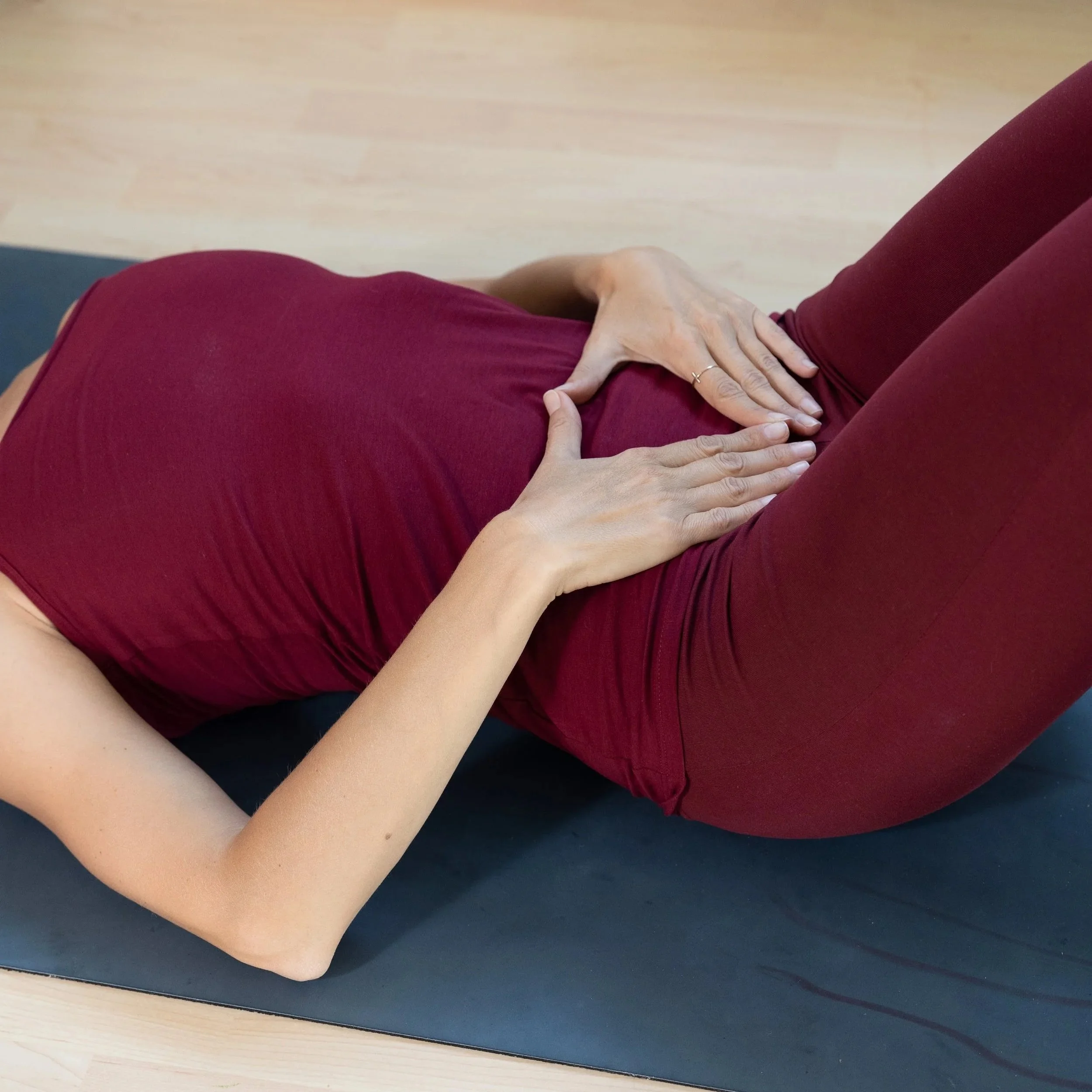
You do not need a clinic to begin understanding your own midline. Your hands already know how to listen, and a simple self-check, done slowly and with curiosity rather than fear, will tell you a great deal about where your body is in its healing.
When to check: the most meaningful time to measure is after the first 40 days, once the womb has returned to its place and the acute swelling of the early postpartum has settled. If you birthed by cesarean, wait until your scar is fully closed and no longer tender, and let your care provider be the first to assess you.
How to check:
Lie on your back with your knees bent and your feet flat on the floor, hip-width apart. Let your belly soften completely and take a few slow breaths.
Place your fingertips horizontally across your midline at the belly button, fingers pointing toward your feet, palm facing you.
Exhale and slowly lift your head and shoulders just a few centimeters off the floor, as if beginning a very small curl. This brings the edges of the rectus muscles together so you can feel them.
Feel for the two muscle edges on either side of the midline and notice how many fingers fit in the space between them.
Notice the depth. Do your fingertips sink softly into the tissue, or do they meet a firm, trampoline-like resistance?
Repeat at two more points: about 4.5 cm (roughly three finger widths) above the belly button and 4.5 cm below it. The separation is often widest at or just above the navel.
Now check the tension. Lower your head, breathe in, and as you exhale, gently draw your lower belly in and up, as if drawing your hip bones slightly toward each other, and lift your head again. Notice whether the midline under your fingers becomes firmer, whether the gap narrows, and whether the ridge you saw before stays flat.
Reading what you find:
Fewer than 2 fingers, a firm midline, and no doming: this is within the normal range for a postpartum body.
2 to 3 fingers, with a midline that firms when you engage your deep core: this is a mild separation that tends to respond well to progressive core rehabilitation.
More than 3 fingers, or fingers that sink deeply into soft tissue: this is a wider or less supported midline that deserves assessment by a pelvic floor physiotherapist.
Doming or coning that you cannot control with breath and deep core engagement: this is a sign the abdominal wall is not yet managing pressure well, so work with a professional before adding load.
The finger test is a starting point, not a diagnosis. A pelvic floor or women's health physiotherapist can measure the inter-recti distance more precisely with calipers or ultrasound, assess the pelvic floor at the same time, and see the whole system rather than a single number.
Please seek medical care if you notice a bulge at or near the belly button that does not flatten when you lie down, pain or tenderness along the midline, or any bulge accompanied by nausea. These can be signs of an umbilical or ventral hernia, which sometimes travels alongside diastasis recti and needs its own assessment.
Chrysalis is Cris's postpartum healing program, and at its heart lies a progressive 8-week core and pelvic floor journey that begins once the first 40 days of rest are complete, rebuilding your center from the breath outward, week by week, for Mothers after physiological and cesarean births alike. Explore Chrysalis
How to Regain Abdominal Integrity After Birth
The abdominal wall does not heal through crunches, and it does not heal through fear. It heals the way all connective tissue heals: through protection first, then gentle reconnection, then load that is introduced slowly enough for the tissue to adapt, remodel, and grow stronger over months rather than weeks. What works is rebuilding the whole pressure system of the body, not chasing a number between your fingers.
Honor the First 40 Days
The first layer of healing is the one our ancestors understood without needing a study to confirm it. In the forty days after birth, the tissue of the abdominal wall is at its softest, and what it needs most is rest, warmth, and protection from strain.
This is the time to lie down more than you sit, and to sit more than you stand. When you rise from bed, roll onto your side first and push yourself up with your arms, so that the midline is not asked to lift the weight of your upper body. Let others carry the laundry basket, the car seat, and the shopping.
Across cultures, Mothers in this window were wrapped: the bengkung in Malaysia and Indonesia, the faja across Latin America, the sarashi in Japan. A well-applied belly binding offers the abdominal wall external support while its own tissue is still soft, and many women describe feeling held, gathered, and more upright within it. It is a companion to healing rather than a cure, and it should never be bound so tightly that it pushes pressure down onto the pelvic floor.
Return to the Breath
Every core restoration begins with the breath, because the diaphragm, the deep abdominals, and the pelvic floor were never meant to work alone. Together they form a cylinder around your organs, and each breath moves that cylinder like a gentle piston: as you inhale, the diaphragm descends, the ribs widen, and the pelvic floor softens down; as you exhale, the pelvic floor and deep abdominals rise and draw in.
Pregnancy disrupted this rhythm. Your ribs flared to make room, your breath moved high into the chest, and your pelvic floor learned to brace. Relearning a slow, wide, 360-degree breath, felt in the back and sides of the ribs as much as the belly, is the quiet foundation on which everything else is built.
Reconnect With Your Deep Core
Once the breath is flowing, the next step is to find the transversus abdominis, the deepest layer of the abdominal wall, which wraps around your waist like a corset, and to feel how it works together with the pelvic floor.
On an exhale, imagine gently drawing your hip bones toward each other, or lifting your pelvic floor as if picking up a blueberry, and feel the lower belly draw softly in. This is not sucking in or bracing. It is a subtle, responsive engagement, and it is this engagement that tensions the linea alba. Research by Diane Lee and Paul Hodges found that activating the deep abdominals before a curl-up reduced distortion of the linea alba, even when the gap itself did not narrow, which is exactly why tension matters as much as width.
Load Gradually, and Let the Tissue Adapt

Connective tissue remodels in response to the demands placed upon it. Too little load and it has no reason to grow stronger; too much, too soon, and it cannot keep up. Healing lives in the patient space between.
A thoughtful progression usually moves through a few stages: breath and connection lying down, then the same engagement in sitting, kneeling, and standing, then movement layered on top, such as leg slides, bridges, and side-lying work, and finally the integration of load, including the lifts, carries, and rotations that motherhood asks of you every day.
The question at each stage is not whether an exercise is forbidden, but whether you can do it while keeping the midline flat and supported, without doming, pain, breath-holding, or pressure in the pelvic floor. If you can, your body is ready. If you cannot yet, step back to what you can do well and give it time. Collagen remodeling unfolds over months, so the Mothers who move steadily through a structured program are the ones who see lasting change.
Tend the Midline in Daily Life
The hours of practice matter, and so do the thousands of small movements in between. Exhale as you lift your baby rather than holding your breath. Carry the car seat close to your body and alternate sides. Avoid straining on the toilet, and support your digestion so that constipation does not add pressure from within. Notice whether you stand with your ribs thrust forward and your pelvis tipped, and let your ribs soften down over your hips.
Nourish the Tissue From Within
The linea alba is made of collagen, and collagen is built from what you eat. Protein, vitamin C, zinc, and gelatin-rich foods such as bone broth and slow-cooked meats give the connective tissue its raw materials, and warm, easily digested meals help a depleted body absorb them. Sleep, however fragmented, is when much of this repair takes place.
Know When to Seek More Support
Most Mothers see meaningful improvement through a consistent, progressive approach. If your separation is wide, if your midline stays soft despite months of practice, or if you notice doming, pain, or pelvic floor symptoms, a pelvic floor physiotherapist is an invaluable ally. For a small number of women with a severe separation or a hernia that does not respond to rehabilitation, surgical repair may be discussed, usually only after at least a year of dedicated conservative care.
The Opening at Your Center
It is easy to look at that ridge along your belly and read it as damage, as proof that birth broke something. I would like to offer you another way of seeing it.
For nine months, the very center of your body opened, softly and deliberately, to make room for another life. The parting of the midline is the physical trace of that making room, written into the tissue of your abdomen. It asks to be met with the same patience with which it was formed: not forced closed in a hurry, but gathered back, week by week, breath by breath, until your center holds again in a way that is stronger and more conscious than before.
The women who came before you knew this in their hands. They bound the belly, warmed it with oils and cloth, kept the new Mother lying down and fed and held, and waited for the body to gather itself. What we can add today is a clearer understanding of how the tissue heals and how to guide it back into strength, and when the two are woven together, the abdominal wall responds.
You have time. Your body is not behind. It is in the middle of its own quiet reconstruction, and it knows the way.
The 7 Pillars of Postpartum Wellness is a free guide to the foundations your body needs to heal after birth, from nourishment and rest to core and pelvic floor care, clearly laid out and without overwhelm. Download free
Frequently Asked Questions About Diastasis Recti
What is diastasis recti?
Diastasis recti is the widening of the space between the two sides of the rectus abdominis muscle, together with a thinning and stretching of the connective tissue that joins them, the linea alba. It develops during pregnancy as the abdominal wall makes room for the growing baby, and it is present to some degree in almost every woman by the end of the third trimester.
How common is diastasis recti after birth?
Very common. In a study of 300 first-time Mothers, a separation of two finger widths or more was found in 60% of women at six weeks postpartum, 45% at six months, and 33% at twelve months. Most of these cases were mild.
How do I know if I have diastasis recti?
Lie on your back with your knees bent, place your fingertips across your midline at the belly button, and slowly lift your head and shoulders. If you can fit two or more fingers between the muscle edges, at the belly button or 4.5 cm above or below it, or if you see a ridge or dome rising along your midline, you likely have some degree of separation. A pelvic floor physiotherapist can confirm this with a more precise assessment.
Can diastasis recti heal on its own?
The gap narrows naturally for many women in the first months after birth, particularly in the first eight weeks. For around a third of Mothers, however, a separation remains a year later, and the tension and function of the midline benefit from targeted, progressive rehabilitation.
When can I start exercises for diastasis recti?
Gentle breathing and deep core connection can begin in the first days after birth, as long as they feel comfortable. A structured, progressive core program is best begun after the first 40 days of rest, and after a cesarean birth once your scar has healed and your care provider has cleared you.
Are crunches bad for diastasis recti?
Not necessarily. No single exercise is forbidden forever. What matters is whether you can perform a movement while keeping your midline flat and supported, without doming, pain, or breath-holding. Curl-ups can become part of a later stage of rehabilitation once your deep core can tension the linea alba well.
Does belly binding help diastasis recti?
Belly binding offers external support to the abdominal wall while the tissue is at its softest, and many Mothers find it comforting and stabilizing in the early weeks. It works best alongside breath and deep core rehabilitation rather than as a replacement for them, and it should never be bound so tightly that it creates pressure on the pelvic floor.
Can I heal diastasis recti years after giving birth?
Yes. Connective tissue continues to respond to load throughout life, and women who begin rehabilitation years after birth can still improve the tension and function of their midline, reduce doming, and feel stronger and more supported in their core.
Cris Dima is a certified postpartum doula, health coach, pre/postnatal fitness specialist, and a hypnobirthing practitioner. She founded The Mother Goddess to hold Mothers in their becoming, through the science, the sacred, and everything in between. Read more about Cris.